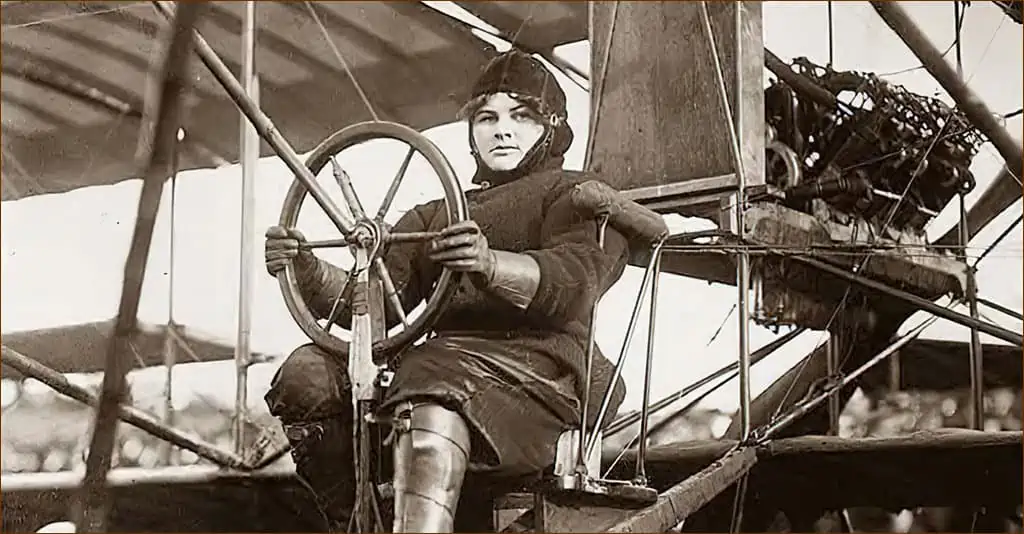
Driving Into the Record Books
Before she ever took off in a Curtiss biplane, Blanche Stuart Scott was already terrorizing the unpaved roads of Rochester, New York. Born in 1884, Scott was driving her father’s automobile by age thirteen, a habit that prompted city council concern and a swift trip to finishing school.
The finishing school failed to temper her spirit. In May 1910, Scott set out from Times Square in a modified Willys-Overland Model 38—dubbed the "Lady Overland"—to drive across the United States. She became the second woman to complete a transcontinental auto journey and the first to do it heading west from New York to San Francisco, covering nearly 3,000 miles over 67 days with only 218 miles of paved roads outside major cities.
The Accidental Solo and Public Debut
Her cross-country drive caught the eye of Jerome Fanciulli, general manager of the Curtiss Exhibition Company, who offered her flying lessons. Glenn Curtiss agreed to instruct her—making Scott the only woman trained directly by Curtiss—though he remained cautious. To keep her grounded while she learned steering mechanics, Curtiss placed a wooden limiter block behind the aircraft's foot throttle.
On September 6, 1910, during a taxi run in Hammondsport, New York, a gust of wind (or a slipped throttle block) lifted her plane 40 feet into the air. She landed safely, earning recognition from the Early Birds of Aviation as the first American woman to pilot an airplane solo.
Scott made her formal public debut on October 23, 1910, at an air meet in Fort Wayne, Indiana, becoming the first American woman to perform at a public aviation event before a crowd of 10,000 spectators.
"The Tomboy of the Air" performed inverted flights and 4,000-foot death dives—pulling up just 200 feet above the ground.
Scott dominated the U.S. exhibition circuit for six years before retiring to challenge gender barriers in commercial engineering.
Beyond the First Flight: Stunt Pilot and Test Pioneer
Scott spent the next six years dominating the exhibition circuit. Beyond her stunt work, her accomplishments established critical early benchmarks in aeronautical testing and media:
Long-Distance Records
Set early American women’s distance marks, including a 10-mile flight in July 1911 and a 25-mile flight in August 1911.
First Female Test Pilot
Joined pioneer Glenn Martin in 1912 as a professional employee, flying prototype aircraft before final engineering blueprints were drawn.
Silver Screen Debut
Starred in The Aviator's Bride (1912), the first motion picture made about aviation.
In 1916, Scott retired from active flying. She cited frustration with growing public fascination with fatal crashes and a lack of professional pathways for women as mechanics, engineers, or commercial aviators.
Later Life and Aviation Legacy
After stepping away from the cockpit, Scott transitioned into media, writing screenplays for RKO, Universal Pictures, and Warner Brothers, as well as producing and hosting radio broadcasts.
She never lost her connection to flight:
First Jet Flight
On September 6, 1948, thirty-eight years after her first hop, Scott became the first American woman to ride in a jet aircraft, flying as a passenger in a TF-80C piloted by Chuck Yeager.
Air Force Museum
In 1954, she joined the United States Air Force Museum as a special consultant, helping the institution acquire over $1,000,000 in early aviation artifacts.
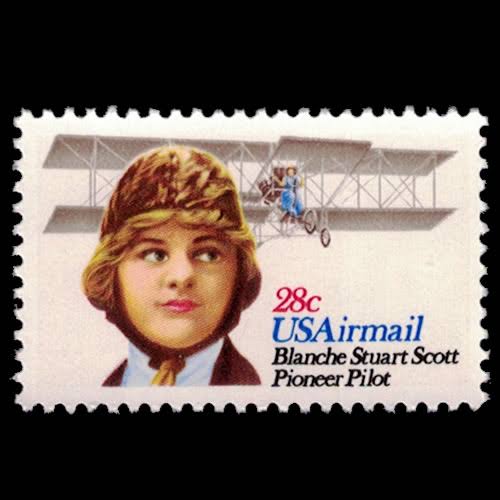
Blanche Stuart Scott passed away in 1970. She was honored posthumously by the U.S. Postal Service with a commemorative airmail stamp in 1980 and inducted into the National Women's Hall of Fame in 2005.
References & Reference Sources
- National Women's Hall of Fame: Blanche Stuart Scott Inductee Profile. womenofthehall.org
- Smithsonian Air & Space Magazine: Fabulist of the Air (Paul Glenshaw). smithsonianmag.com
- National Air and Space Museum Archives: Blanche Stuart Scott Papers and Photographic Collection. airandspace.si.edu
- U.S. National Postal Museum: 1980 Pioneer Aviation Series: Blanche Stuart Scott Commemorative Issue. postalmuseum.si.edu